Our First Experience Launching a ChatGPT Ads Campaign
Our First Experience Launching a ChatGPT Ads Campaign
At OVC Lawyer Marketing, we recently launched our first paid ads campaign inside ChatGPT.
Because this is still a newer advertising environment, we wanted to document what we saw during setup, what stood out, and what marketers should pay attention to as AI-driven advertising continues to develop.
For us, this was especially interesting because it sits directly at the intersection of several areas we are already watching closely: SEO, GEO, paid placement, AI search, lead generation, and digital strategy for law firms.
This is not a final performance review. It is an early operational look at the setup process and the questions we are already asking as this channel develops.
ChatGPT Ads Setup: What We Learned From Our First Campaign
When a new advertising platform or search feature begins rolling out, marketers tend to move quickly. People start searching for setup guides, screenshots, early observations, best practices, limitations, and real experiences from those testing the system.
That is one reason fresh, firsthand content matters.
Google has long recognized that some search queries deserve newer information. This concept is often referred to as Query Deserves Freshness, or QDF. In simple terms, when a topic is developing quickly, newer content can become especially valuable because older information may not answer what users need right now.
ChatGPT ads fall into that category.
Searches around "ChatGPT ads," "OpenAI ads," "ads inside ChatGPT," "ChatGPT paid ads," and "how ChatGPT ads work" are tied to a product area that is still evolving. That means marketers, business owners, and agencies are not just looking for general theory. They are looking for current examples, actual screenshots, and practical notes from people who have gone through the setup process.
That is why we believe documenting early experiences is useful. The value is not just in being early. The value is in being specific, honest, and practical while the channel is still taking shape.
The Most Interesting Part: Targeting Feels Context-Driven
The biggest difference we noticed right away is that the targeting process feels more context-driven than traditional keyword-driven campaign building.
Instead of building around a classic list of search keywords, much of the targeting work happens inside the context hints field.
That changes the mindset of campaign setup.
Rather than thinking only in terms of search terms, we approached the setup by defining:
-
who we wanted to reach
-
who we did not want to reach
-
what problems they are trying to solve
-
what buying signals matter
-
what services they may be researching
-
what competitive frustrations they may already have
That meant we spent a meaningful amount of time refining the customer profile and intent language inside that context field.
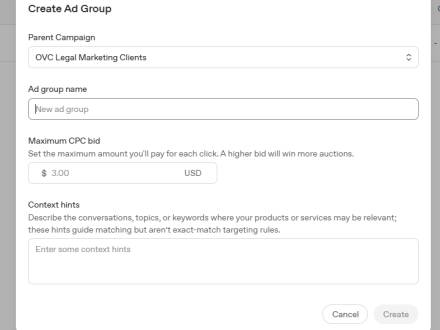
After testing different approaches, we landed on a roughly 800- to 1,000-word context description.
That may sound long, but it made sense for what we were trying to accomplish. We did not just want the platform to understand that OVC provides marketing services. We wanted it to understand the specific type of law firm that may be a good fit for us.
Our context hints covered:
-
ideal customer size
-
relevant law firm practice areas
-
buyer pain points
-
dissatisfaction with competing marketing providers
-
SEO, GEO, PPC, and website-related intent
-
lead quality concerns
-
non-fit audiences to avoid
For example, we wanted to reach law firm owners, partners, managing attorneys, and legal marketing decision-makers who are actively researching ways to improve digital marketing performance.
We also wanted to clarify that we are a stronger fit for firms that already understand the value of marketing but may be frustrated with their current results, communication, lead quality, or lack of strategy.
That distinction matters.
A firm casually looking for general marketing tips is not the same as a firm actively comparing legal marketing providers after being disappointed with another agency.
The more clearly we could define those differences, the stronger the context hints became.
Context Hints May Become a Major Targeting Skill
One of our biggest early takeaways is that the context hints field may be one of the most important parts of campaign setup.
The more clearly a business can define who it wants to reach, who it does not want to reach, what its ideal customer cares about, and what buying signals matter, the better the foundation appears to be.
This may become an important skill for advertisers.
In traditional search advertising, keyword research is central. In this type of environment, customer definition and prompt-style targeting may become just as important.
That means campaign strategy may start requiring a blend of:
-
media buying experience
-
audience research
-
customer profiling
-
search intent analysis
-
prompt engineering
-
conversion strategy
For agencies, this is especially interesting. A vague context hint will likely produce vague matching. A detailed, thoughtful context hint gives the system more to work with.
That does not mean writing long context just to write long context. It means writing context that is specific, structured, and tied to real business goals.
Our Initial Campaign Objective: Clicks First
For our initial campaign objective, we selected Clicks.
That decision was practical. Since this is a new channel for us, we wanted to start by observing traffic behavior, delivery patterns, and pricing before over-optimizing around assumptions.
We also started with a low maximum CPC bid. The goal was to benchmark early pricing and see how delivery behaves at a conservative starting point.
At the time of setup, the available objectives appeared to be:
-
Reach
-
Clicks
Conversions appeared to be listed as coming soon.
That is important because it gives some context for where the platform currently appears to be in its rollout. For now, advertisers may need to think like early testers: gather data, watch traffic quality, use UTMs, monitor behavior carefully, and prepare for optimization options to mature over time.
Ad Group Structure Is Simple Right Now
The ad setup itself is currently straightforward.
At this stage, the structure appears to include:
-
one headline
-
one description
-
one image
-
one link destination
-
one ad group context profile
That simplicity makes the first launch approachable. It also raises some interesting questions about how creative testing will develop.
For example:
-
Will advertisers eventually be able to test multiple headlines within one ad group?
-
Will multiple images be supported in a more dynamic format?
-
How much weight will the context hints carry compared with the ad creative?
-
How will A/B testing work as the platform matures?
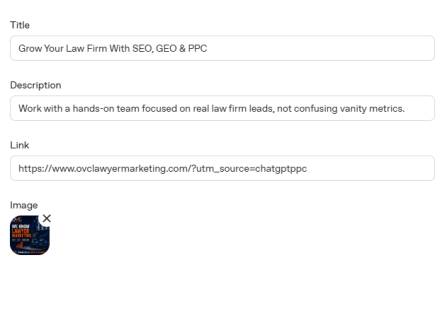
For our first ad, we wanted the message to be direct and tied to what matters most for our clients: visibility, real leads, and marketing performance.
We used a message focused on SEO, GEO, PPC, and lead generation because those are areas where law firms are actively trying to understand how search behavior is changing.
Tracking Setup Took More Digging Than Expected
One of the more important operational observations involved tracking and conversion setup.
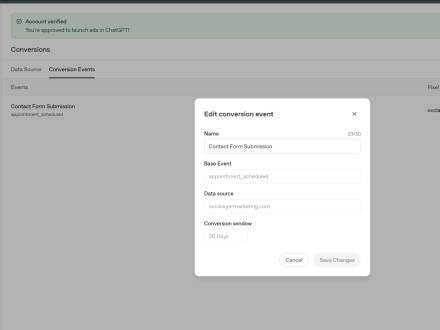
We were able to add a data source and create a conversion event, but it was not immediately obvious during the campaign creation process itself.
The path we found was:
Settings → Conversions → Add Data Source → Create Conversion Event
Once we found the correct area, we were able to:
-
add the site as a data source
-
install the tracking script
-
place the script in the website’s head file
-
create a conversion event
This worked, but it also raised follow-up questions.
At this stage, we did not yet see a clear way to specify exact form submissions, button clicks, chat actions, or HTML elements to track in the same way advertisers may expect from more mature ad platforms.
That part matters a lot to us.
At OVC, we do not measure success based only on traffic graphs or surface-level engagement. Those numbers can be useful, but they are not the final business outcome.
For our clients, what matters most is whether marketing is helping create real opportunities.
That means tracking:
-
contact form submissions
-
chat leads
-
phone calls
-
qualified inquiries
-
actual leads in the door
Marketing reports should help explain business results, not hide behind confusing metrics that look impressive but do not connect clearly to value.
So while the tracking framework is promising, conversion clarity is one of the areas we will be watching closely as the platform continues to develop.
[SCREENSHOT_1_CONVERSION_EVENT_SETUP]
UTM Tracking Helped Fill in Some Gaps
Because some parts of native tracking are still developing, we added a custom UTM parameter to the campaign URL.
That gives us a way to identify the traffic source more clearly inside our own analytics and reporting systems.

This is one of the practical recommendations we would make to any business testing a newer ad channel.
Bring your own measurement discipline.
That means using:
-
UTM tracking
-
landing page analytics
-
CRM source tracking where possible
-
lead source tagging
-
internal conversion review
-
manual quality checks early on
New ad platforms are exciting, but excitement does not replace attribution. A campaign still needs to be judged by whether it produces meaningful business activity.
Location Targeting Appears Limited Right Now
Another thing we noticed is that location targeting options did not appear to be available yet.
For our use case, that is something we will be watching closely. Many law firms care deeply about geography, especially firms focused on local SEO, local service areas, or specific cities and counties.
That said, the absence of location controls makes sense for an early rollout.
For now, much of the targeting logic appears to depend on:
-
context hints
-
user intent
-
conversation topics
-
relevance between the user’s need and the advertiser’s offer
That makes this system feel different from a traditional search campaign where geography, keywords, bids, and match types do most of the work.
This feels more like a blend of search relevance, conversational intent, and contextual matching.
The Onboarding Process Was Smooth
One positive part of the experience was the approval and onboarding flow.
Getting accepted and getting started felt smooth and streamlined. For an early advertising product, that matters. If the initial setup process is too difficult, many businesses will never get far enough to test the channel meaningfully.
In this case, the process felt approachable.
That makes it easier for advertisers to begin learning the system and testing campaigns without getting stuck in unnecessary setup friction.
API Access on Day One Is a Big Deal
Another part that stood out was API access being available early.
For businesses with custom CRMs, internal dashboards, or operational workflows, this could become very valuable.
From our perspective, API access creates future potential for:
-
custom CRM integrations
-
lead attribution workflows
-
internal reporting dashboards
-
automated campaign monitoring
-
business operations tracking
-
cross-channel performance analysis
For agencies, this is especially important. The more a platform can connect into real business systems, the more useful it becomes beyond the ad dashboard itself.
Clicks and impressions matter, but businesses ultimately need to connect marketing activity to actual opportunities.
What This Means for Marketers
Stepping back, there are a few broader takeaways from our first setup experience.
1. AI Advertising May Be More Intent-Native
Traditional search ads are built around what people type into a search box.
This environment feels more connected to what people are asking, researching, comparing, and trying to solve inside a conversation.
That is a meaningful shift.
2. Prompt-Like Targeting May Become a Core Skill
If context hints continue to matter, advertisers will need to get better at describing customer fit, buyer intent, pain points, exclusions, and service relevance.
This is not just media buying. It is strategic communication with the ad system itself.
3. Measurement Still Matters More Than Hype
The platform is interesting, but performance discipline still matters.
No matter how advanced a new ad channel becomes, businesses still need to ask:
Did this create qualified leads?
Did this support revenue?
Did this create actual business value?
If the answer is unclear, the campaign needs better tracking, better targeting, or better strategy.
4. Early Content Has Strategic Value
For fast-moving topics, publishing firsthand observations can be useful for both users and search visibility.
People searching for information about new ad products do not want vague predictions. They want current details, screenshots, limitations, setup notes, and practical takeaways.
That is why experience-based content matters. It helps others learn while the topic is still developing, and it creates a stronger foundation for future updates as the system changes.
Our Current View: Promising, Early, and Worth Watching
Overall, our first experience launching a paid ads campaign inside ChatGPT left us encouraged.
The system is clearly still developing, but it is also clearly worth watching.
What stands out most is the way several disciplines are beginning to overlap:
-
AI search
-
paid placement
-
SEO
-
GEO
-
conversational intent
-
lead generation strategy
-
CRM attribution
-
digital advertising operations
That overlap is likely to become more important over time.
For now, we are eager to see what the data shows, how the platform’s controls mature, how conversion tracking improves, and how performance develops.
As with any new marketing channel, the real answer will not come from hype alone.
It will come from measured testing, real lead quality, and long-term business results.
Final Thoughts
If you are a marketer, agency, or business owner watching the emergence of ChatGPT ads, our early advice is simple:
-
test carefully
-
define your audience clearly
-
be specific in your context hints
-
use UTM tracking
-
verify conversions independently
-
focus on leads, not vanity metrics
-
document what you learn while the space is still developing
There is a real chance that AI-driven ad placements become an important part of the next chapter of digital advertising.
We are glad to be testing it now.
Want Help Navigating SEO, GEO, Paid Media, and AI Visibility?
As AI search, SEO, GEO, and paid media continue to blend together, law firms need marketing strategies that are built around visibility, clarity, and real lead generation.
At OVC Lawyer Marketing, we continue to watch emerging digital channels closely while staying focused on what matters most: real leads, real growth, and clear strategy.
If your law firm is looking for a hands-on marketing team that understands legal SEO, websites, paid ads, content, and the future of AI-driven visibility, contact OVC Lawyer Marketing to start the conversation.